
Comet isn’t a search engine.
It’s not just another AI gadget in a sea of noisy assistants.
It’s a tool that, behind its modest appearance, rewires the structure of digital thought.
Most users see it as a “smart Google.”
That’s a perspective error.
Google answers you. Comet reframes you.
Google guides you through a labyrinth of hyperlinks.
Comet shows you the map of the labyrinth.
And that difference—invisible to the hurried eye—is what makes Comet fascinating.
Because Comet doesn’t try to do the thinking for you.
It thinks with you.
-
From Search to Cognition
For the past 20 years, we’ve confused speed with clarity.
We type a question, click, scan ten tabs, and move on.
This habit of instant execution has created the illusion of external intelligence that “understands” us.
Comet is born of collective fatigue.
Click fatigue. Scroll fatigue. Repetition fatigue.
Its stated ambition from parent company Perplexity isn’t to “answer better” but to shift browsing into cognition.
“From navigation to cognition. From answers to action.”
— Official launch vision of Perplexity for Comet
In other words: Comet isn’t a doorway to information. It’s an interface that leans on information to generate new connections.
It’s not about searching anymore. It’s about structuring.
-
Why Comet Is Not “Google With AI”
The reflex is to compare. So let’s compare properly:
|
Dimension |
|
Comet |
| Typical Output | List of 10 blue links | Structured synthesis with clickable sources |
| Action Possibility | Click on a link | Interact, extract, automate a task |
| Cross-tab Intelligence | None | Multi-tab navigation with real-time comparison |
| Unit of Information | Indexed page | Semantic relation between ideas |
| Dominant Mechanism | Popularity-based ranking | Contextualized dynamic synthesis |
| Publisher Compensation | Ads and indirect traffic | Direct micropayment via Comet Plus |
| Decision Use Case | Manual collection, later arbitration | Built-in scenario analysis with contradictions |
The real difference lies not just in the engine but in the posture:
Google shows pages. Comet acts on them.
It can extract data across tabs, auto-populate a table, compare prices, summarize email threads, or execute code sequences.
You move from spectator mode to operator mode.
That shift transforms the cognitive nature of the question itself.
Comet vs Chrome: the new AI browser war.
-
A Machine That Structures Thought
Comet inverts our relationship to information.
Instead of stacking sources, it organizes them.
Instead of multiplying evidence, it imposes hierarchy.
For a decision-maker, this means three shifts:
- Stabilizing the Question.
Comet reformulates, confronts, sharpens. It acts as a logic mirror.
It doesn’t deliver quick answers. It gives you precise questions. - Creating Heuristic Tension.
By forcing contradictory viewpoints to coexist, it clarifies your evaluation criteria.
It’s no longer an assistant. It becomes a dialectical partner. - Structuring the Output.
Comet doesn’t dump data. It delivers an operational synthesis: criteria, angles, sources, contradictions.
You think better because you see better.
Think of it this way:
Comet is like Excel for non-quantitative thought.
You manipulate hypotheses like cells, connect arguments like formulas, build dynamic mental models.
-
The War on Cognitive Bias
The real issue isn’t technical. It’s cognitive.
Comet doesn’t replace human thinking. It puts it under pressure.
That pressure reveals a fundamental bias: lazy questioning.
Most users ask descriptive questions:
“What are the benefits of…”, “How to…”
Comet can answer them, but it’s a waste of potential.
What it wants is an asymmetric question—an open hypothesis that exposes the gap between what you think you know and what you need to test.
That’s the logic behind the Asymmetric Questioning Model (AQM):
a method for formulating prompts that force clarity.
Examples:
- “In what cases does a premium pricing strategy fail, even with high perceived value?”
- “What weak signals contradict market consensus for 2025?”
- “If a player half our size gains 5% market share, what strategic arbitrage did they succeed at?”
Documented example:
Prompt:
“Imagine a competitor half our size gains 5 points of market share in B2B logistics within 12 months. Identify three strategic arbitrages they must have executed, then propose two countermeasures compatible with our cost structure.”
Actual Comet Response (summary):
- Focused on a stable-margin segment ignored by leaders.
- Aggressively differentiated via service, not price.
- Partially outsourced logistics for 20% flexibility gain.
Proposed countermeasures:
- Rebuild value proposition around delivery time, not pricing.
- Launch “service proof” campaign with public benchmark data.
What matters isn’t precision.
It’s the cognitive tension.
Comet forces implicit assumptions into explicit form.
The decision-maker sees blind spots materialized as structured arguments.
-
Asymmetry as Strategic Method
Asymmetry isn’t about contradiction. It’s intellectual discipline.
It introduces a deliberate gap between what you believe and what you test.
In Comet, that means:
- Imposing Constraints.
Time, budget, legal, resources. Without limits, everything is true and nothing is useful. - Declaring Evaluation Criteria.
No more than three: one quantitative, one qualitative, one temporal. - Demanding Two Opposing Scenarios.
Truth often lies in the comparison.
Comet doesn’t save time. It generates clarity.
It disciplines thought through formalization.
-
What Comet Really Changes: From Engine to Agent
Comet is no longer a passive tool.
It’s an agent.
It can:
- Open airline tabs and auto-compare prices
- Extract data from an article and export it into a spreadsheet
- Summarize a full Gmail thread with action hierarchy
- Generate code, insert it into an editor, and execute tasks
These features rely on a Chromium architecture enhanced with multimodal generative AI (GPT-4o, Claude 3.5, and Perplexity’s own models), allowing real-time contextual analysis.
This agentive capacity redefines the web.
Comet no longer shows you pages. It operates through them.
Assistant vs Agent: The cognitive shift of 2025.
- Assistant mode remains conversational.
- Agent mode acts.
It manipulates, compares, executes.
This shift changes everything: the user is no longer a content browser but a conductor of cognitive processes.
-
A Concrete Use Case: Automated Audit
Real case: Competitive audit in SaaS.
Prompt to Comet:
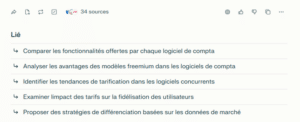
“Accounting software. Open the ‘Pricing’ pages of five direct competitors. Extract pricing models (free, freemium, per user, etc.). Compile the data into a structured table. Detect gaps in value/volume positioning. Suggest two possible differentiation insights.”
Time: less than 1 minute.
Output: Clear, legible table, ranked by business model.
The positioning gaps popped instantly.
What stands out isn’t speed. It’s structure.
Comet forces you to name your criteria before analysis.
It transforms monitoring into method, observation into arbitration.
| Vendor | Pricing Model | Entry Price (USD) | User Volume Included | Plan Types | Notes |
| QuickBooks | Subscription, per plan | $38/mo (Simple) | 1 (Advanced up to 25) | Simple Start, Essentials, Plus, Advanced | No meaningful free plan (only trials), annual increases |
| Xero | Subscription, per plan | $39/mo (Starter) | 1 user + accountant | Starter, Standard $70, Premium $95 | Unlimited users in higher tiers |
| FreshBooks | Subscription, per plan | $21/mo (Lite) | 5 clients (Lite), user-based | Lite, Plus $38, Premium $65, Select | Lite restricts client volume, higher = unlimited |
| Sage 50 | Subscription, per module | $61/mo (Pro) | Single user base | Pro $61, Premium $94, Quantum $160 | Scales with user/modules, bundles HR/payroll |
| Sage X3/100 | Subscription + modules | From $56/user/mo | Fully customizable | Modules scalable, ERP bundles | Pricing upon request, depends on config |
| Wave | Freemium (core) | $0 | Unlimited | Core free, pay for payroll, etc. | Free access for most small businesses |
Value / Volume Analysis:
- QuickBooks is a clear market reference: strong segmentation by feature set; jumps in price occur with “Advanced” tier, which opens up to more users and batch features.
- Xero and FreshBooks push value differentiation through client/user volume caps: plans upgrade when client list grows, rather than strictly per user.
- Sage focuses pricing modulation on breadth of modules and user base, with high-end models fully customizable for enterprise.
- Wave stands out with a true freemium offer for core accounting—no cost for unlimited users—targeting micro-businesses and startups.
Differentiation Insights:
- Transparent scaling by business stage: Offering clear per-user or per-client scaling, with proactive scenario calculation (“what’s my cost at year 2, 10 users, 500 clients?”). Most US vendors obscure real scaling costs beyond entry level.
- Enterprise feature-bundling minus complexity: Sell modular bundles (ERP+HR+project or full-service packs) that can be instantly toggled “on/off” per month, versus annual commitment—removing “lock-in” and boosting perceived flexibility.
This US market structure confirms that true freemium (Wave) and intuitive pricing simulation are powerful levers unaddressed by most legacy publishers, and that ease of “upgrade/downgrade” is a key frustration for mid-market buyers.
-
Cognitive Implications
AI doesn’t just boost productivity.
It reveals the structure of the user’s mind.
Comet acts like an epistemic mirror:
- It shows your shortcuts.
- Amplifies your blind spots.
- Materializes your biases.
Used properly, it becomes cognitive training for decision-makers.
Asking a question in Comet is asking yourself who you are when you think.
-
What Comet Changes for Online Credibility
In the classic web, authority came from links.
In the AI ecosystem, it will come from semantic coherence.
Comet cites, links, and pays the content it uses.
Since October 2025, access is free, but Comet Plus compensates sourced publishers directly.
This transforms the attention economy:
Value isn’t in clicks. It’s in intellectual density.
Consequences:
- Three dense, coherent, quotable articles beat content overload.
- Texts must be alive: updated, self-linked, source-worthy.
- Video remains useful for storytelling, but proof of authority stays textual.
The future of online credibility lies in semantic depth:
Who feeds the AI, not who chases the clicks.
-
How to Think With Comet: A 7-Step Method
- Form a Hypothesis, Not a Question.
(“What happens if…”, not “How do I…”) - Set Your Constraints:
Time, budget, legal, resources. - Request Two Opposing Scenarios.
- Define Max Three Evaluation Criteria.
- Ask for Sources and Proof.
- Build an Actionable Output:
Table, plan, choice. - Revisit After 24h:
Rephrase the question, compare outcomes.
This looks simple. It isn’t.
It turns Comet from productivity assistant into a rational arbitration engine.
-
What a CXO Gains in Reality
For executive teams, Comet becomes a simulation chamber:
- Run credible what-ifs without PowerPoint
- Test competing narratives
- Get instant synthesis of relevant sources
Comet acts as a strategic sandbox. A zone where ideas clash before being presented.
The goal isn’t the “right answer.”
It’s reducing the illusion zone.
-
The Comet Ecosystem: What’s Changing
Since late 2025:
- Clear separation between Assistant (passive) and Agent (active) modes
- Free access, premium via Comet Plus
- Media partnerships (Le Figaro, Le Monde, Financial Times) for trusted sources
- Growing Chrome extension compatibility
- Mobile app in internal beta
Direction is clear: Comet isn’t replacing search engines.
It’s replacing cognitive fragmentation.
-
Comet’s Limits (and Strength)
Comet isn’t infallible.
It still hallucinates. It omits. It oversimplifies.
But its value isn’t in perfect answers.
It’s in the discipline it demands:
- Clear hypotheses
- Measurable criteria
- Tolerance for doubt
It’s not a machine that thinks for you. It’s a machine that forces cleaner thinking.
-
A New Paradigm
We’re entering an era where the key skill isn’t “searching fast.”
It’s “thinking accurately with AI.”
Comet is the first interface to demonstrate this in practice.
Where chatbots talk, Comet observes.
Where Google sorts, Comet structures.
Where the user once consumed, they now reason.
This isn’t a tech leap.
It’s a cognitive mutation.
-
In Summary
- Comet isn’t a search engine. It’s a structuring agent.
- AQM is the key: frame the right asymmetry, not the perfect question.
- Agent-mode (actions, automation) changes user roles.
- Online authority now comes from coherence, not volume.
- Lucid leaders aren’t those who master AI, but those who question it sharply.
Conclusion: Thinking Beside Yourself
Comet doesn’t give answers.
It imposes a rhythm.
A rhythm of thought that watches itself function.
The real question isn’t “how to use Comet.”
It’s “how to think with Comet.”
It’s not a tutor. It’s a rational mirror.
A machine of productive contradiction.
In a world drowning in automation tools, real luxury is rare:
A space where thinking remains an act.